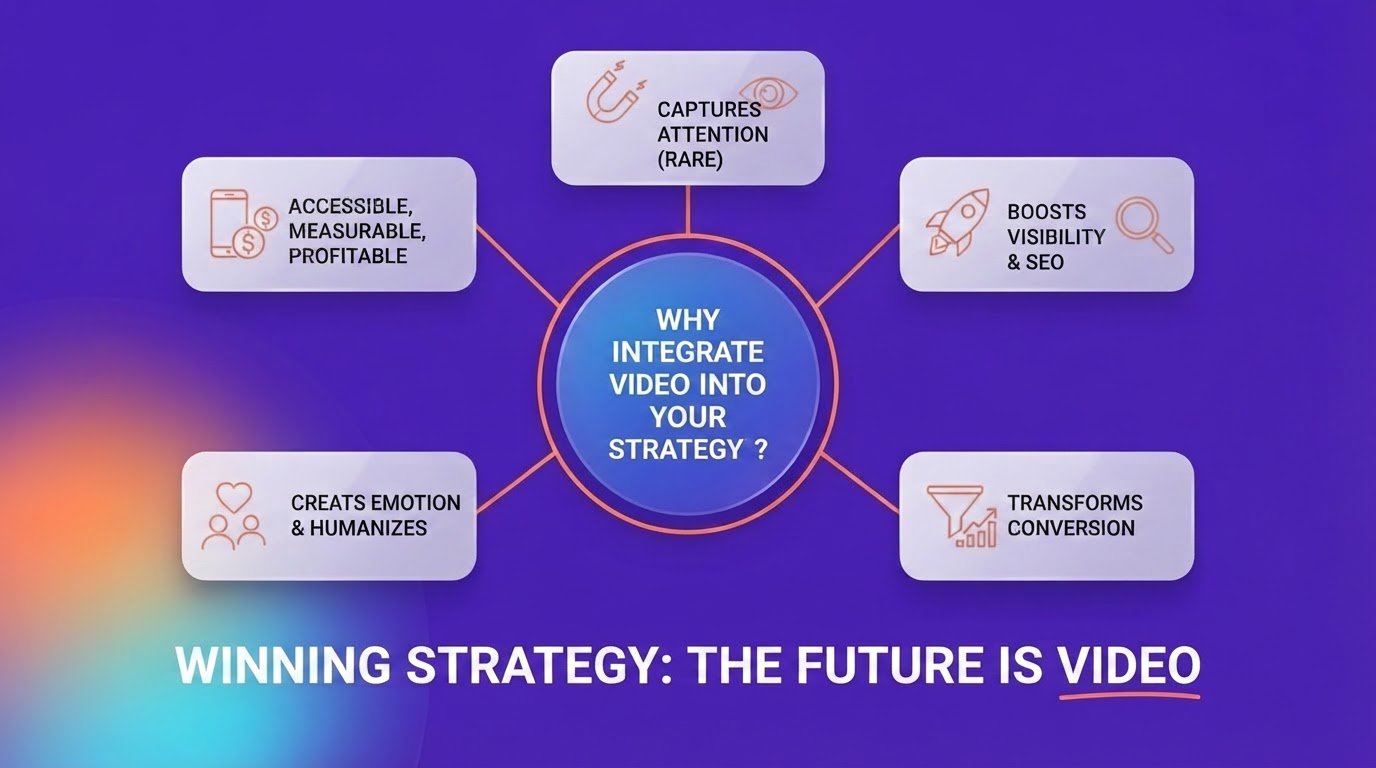
Today, to be persuasive, your communication must be seen, experienced, and shared.
Why Should You Incorporate Video into Your Communication Strategy?
2008.
Steve Jobs pulls the iPhone out of his pocket and announces the App Store. No one knows it yet, but the world of communication has just been turned upside down. Fifteen years later, we spend three hours a day on our smartphones, two of which are spent watching videos. The brands that anticipated this revolution dominate their markets. The others are still playing catch-up.
2026.
Your competitor posts a video. Within 48 hours, it generates more engagement than all of your static posts from the past six months combined. Your management asks why you don’t have a video strategy. You reply that “it’s expensive, complex, and time-consuming.” Meanwhile, your market share is eroding.
The real question is no longer “Why incorporate video?” It’s “Can you really afford not to?” Because by 2026, video will no longer be just one communication channel among many. It will be the dominant language of the digital world, the format algorithms prefer, and, above all, the only one capable of instantly creating the emotional connection that all brands are desperately seeking.
Let’s explore together why video has become indispensable and how it can radically transform your communication impact.
Attention: That Scarce Resource
In a world saturated with information, attention has become the most valuable resource. Every brand is shouting to be heard. Every post is fighting to be noticed. The noise of communication is deafening. And amid this chaos, video has a unique power: it captures the eye through movement, holds the attention through rhythm, and leaves a lasting impression through emotion.
A text post—even a brilliantly written one—can be scrolled past in half a second. A static infographic, no matter how well designed, only draws a passive glance. A video, on the other hand, creates an interruption. The movement triggers an attention reflex. Sound (even when muted with subtitles) adds an immersive dimension. Storytelling builds engagement gradually. In 15 seconds, you can make a bigger impact than with 500 words of text.
Video boosts your visibility and search engine rankings
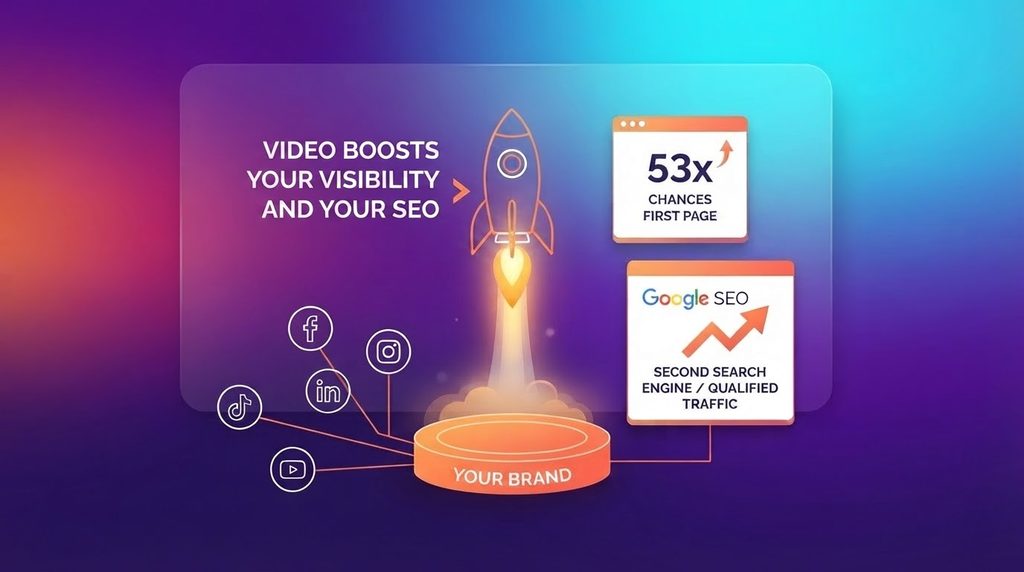
Algorithms love video
Facebook, Instagram, LinkedIn, TikTok, YouTube… All social media platforms heavily prioritize video content in their algorithms. Why? Because video drives engagement. A user who watches a video stays on the platform longer. They generate more ad views. They create more value for the social network.
Concrete result:
A LinkedIn video post generates, on average, 5 times more organic reach than a text or image post. On Instagram, Reels receive priority distribution to new accounts. On Facebook, native videos (uploaded directly) generate 10 times more engagement than YouTube links. Platforms don’t just favor video—they actively penalize static formats.
Google and Video SEO
Including video on your website is no longer optional for your SEO. Pages that contain video are 53 times more likely to appear on the first page of Google. A video on your homepage increases the time spent on the site by 88%.
However, session duration is a key factor in Google’s ranking.
Even better:
YouTube is the world’s second-largest search engine after Google (which, incidentally, is owned by the same company). Millions of people search for answers to their questions directly on YouTube. If you’re not there with optimized videos, you’re leaving a massive source of qualified traffic to your competitors. Video SEO is no longer a niche—it’s a major component of any digital visibility strategy.
Video Boosts Your Conversion Rate
From Consideration to Purchase
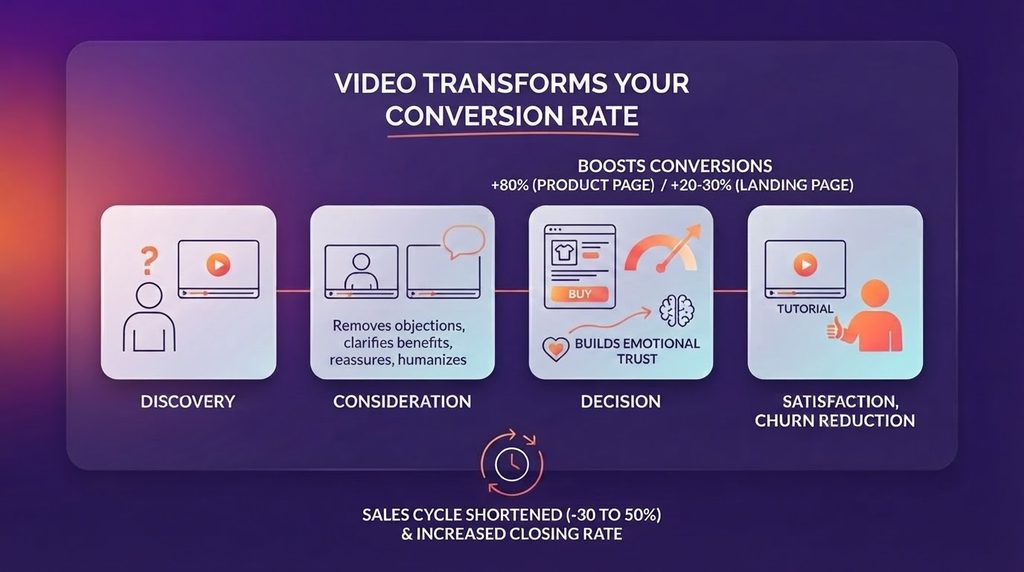
Including a video on a product page increases conversions by an average of 80%. On a landing page, an explanatory video can improve the conversion rate by 20 to 30%. Why is it so effective? Because video addresses objections, clarifies benefits, reassures customers about quality, and humanizes the brand.
A potential customer is always hesitant before making a purchase. They have doubts. They compare options. They’re afraid of making the wrong choice. A well-designed video answers their unspoken questions. It shows the product in action. It demonstrates value through testimonials. It turns the abstract into the concrete. In a three-minute video, you can accomplish what 20 pages of descriptive text will never be able to do: build the emotional trust that triggers a purchase.
The Optimized Video Conversion Funnel
A well-developed video strategy guides the prospect through every stage of their journey. During the discovery phase, short, impactful videos build brand awareness. During the consideration phase, explainer videos and customer testimonials build preference. During the decision phase, product demos and comparisons make the choice easier. After the purchase, video tutorials improve satisfaction and reduce churn.
Each video plays a specific role in the conversion process. Together, they create a persuasive ecosystem that naturally guides the audience toward the desired action. Companies that master this video strategy see their sales cycle shortened by 30 to 50 percent and their closing rate increase significantly.
Video humanizes your brand and evokes emotion
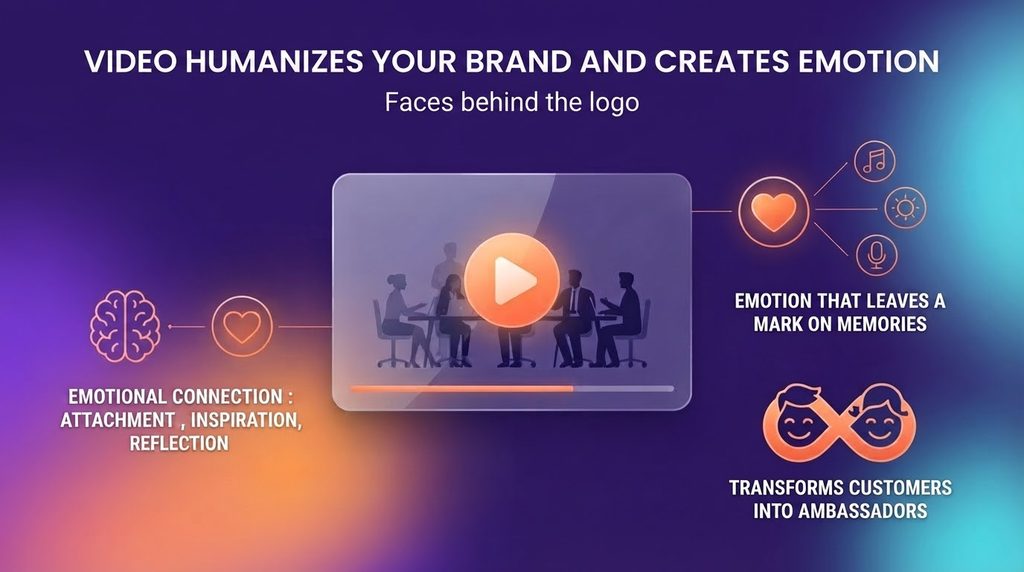
The Faces Behind the Logo
In an increasingly digital world, audiences are desperately seeking a human touch. They want to know who’s behind the brand—who works at the company and what values truly drive them. Video offers a window into that authenticity that no other format can match.
Show your teams at work. Film your leaders explaining their vision. Capture your employees passionately describing their jobs. These “behind-the-scenes” videos foster a sense of connection, goodwill, and trust. They transform an abstract corporate entity into a real, human community. And people buy from people, not from logos.
The Emotion That Sticks in People’s Minds
Video storytelling has the unique power to evoke complex emotions in just a few seconds. Music sets the mood. Images evoke sensations. Testimonials touch the heart. Words resonate differently when spoken sincerely on camera.
A brand that evokes an emotional response leaves a far deeper impression than one that merely informs. Video is the ideal medium for fostering this emotional connection. It allows us to tell stories that move, inspire, and provoke thought. These stories create a bond with the brand that goes beyond a simple commercial relationship. It is this emotional dimension that transforms customers into brand ambassadors.
Video: Accessible, Measurable, Cost-Effective
The Democratization of Production Resources
The classic objection: “Video is too expensive.” This belief dates back to a time when producing a video required a large film crew, expensive equipment, and weeks of post-production. Those days are long gone.
By 2025, you’ll be able to produce professional-quality videos with a recent smartphone, a €50 lavalier microphone, and a free editing app. AI tools can generate automatic captions, enhance audio, and stabilize footage. Of course, some projects still require elaborate productions. But an effective video strategy combines premium content with agile, in-house-produced content.
The real cost isn’t production anymore. It’s NOT having a video when all your competitors do. It’s losing visibility, engagement, and conversions because you didn’t dare take the plunge.
Precisely Measurable Results
Unlike many communication efforts whose impact remains unclear, digital video offers complete traceability. You know how many people viewed your video, how many watched it all the way through, at what point they stopped watching, how many clicked on your CTA, and how many subsequently converted.
This data allows you to continuously optimize your strategy. Is a video underperforming? Analyze the metrics, identify the problem (weak hook, too long, confusing message), and make adjustments for the next one. This iterative improvement turns your video production into an increasingly effective machine.
Where should you start with your video strategy?
Set Your Goals Before Deciding on Your Formats
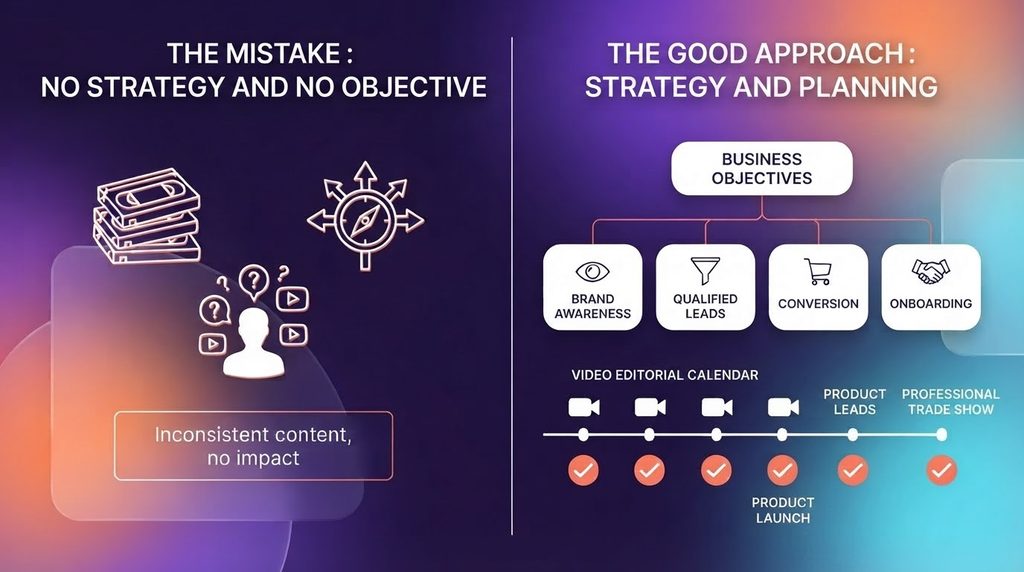
The classic mistake :
Jumping into production without a clear strategy. “We’re going to make videos because we have to.” The result: content that lacks coherence and impact, and serves no concrete business purpose.
The right approach:
Start by identifying what you want to achieve. Increase brand awareness? Generate qualified leads? Improve your conversion rate? Streamline customer onboarding? Each goal calls for specific video formats, tailored messages, and different distribution channels.
Create a video editorial calendar
Consistency beats intensity. It’s better to post one high-quality video a week for a year than to post 20 mediocre videos in a single month and then stop. Create a realistic schedule that you can stick to over the long term. Alternate between short and long formats, educational and emotional content, and spoken segments and testimonials.
This schedule should align with your overall business strategy. Launching a new product? Prepare a series of explainer videos. Attending a trade show? Create teaser videos beforehand, live streams during the event, and post-event recaps. Video doesn’t work in isolation—it amplifies all your other communication channels.
Video: The Investment That Transforms Your Communication
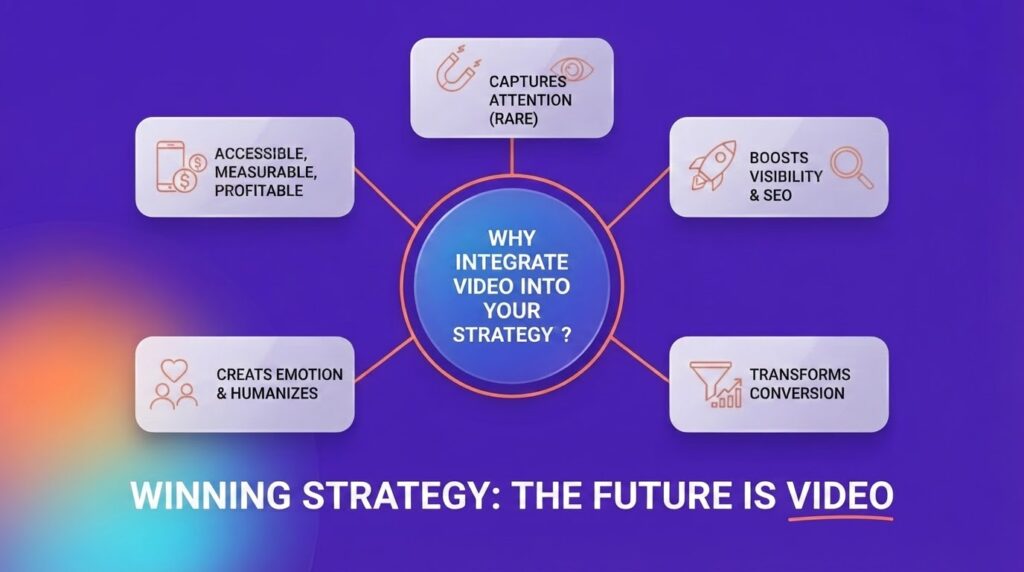
Incorporating video into your communication strategy is no longer just a matter of staying modern or projecting a certain image. It is a strategic necessity for remaining visible, relevant, and competitive. Audiences demand it. Algorithms favor it. Conversions validate it.
But beyond the numbers and performance metrics, video offers something infinitely more valuable: the ability to tell your story in an authentic and memorable way. To create that emotional connection that turns cold prospects into engaged customers. To bring your brand to life in a way that no other format can.
The companies that will dominate their markets in 2025 won’t necessarily be the largest or best-funded. They will be the ones that have figured out how to use video to create meaning, emotion, and value for their audience.
Let’s bring your communication strategy to life
At La petite production, we’ve been helping companies with their video transformation for 15 years. We know that an effective video strategy is about more than just producing content. It requires a clear vision, specific goals, narrative consistency, and technical expertise.
Whether you’re starting from scratch or looking to take your existing approach to the next level, we’ll work with you to build a video strategy that truly addresses your business challenges. No gimmicky videos. No content just for the sake of it. Just productions that generate measurable impact.
Your story deserves to be told on video. Let’s tell it together.
👉 Let’s discuss your video strategy.
Discover our other articles

Corporate video: an essential asset for your employer brand

Artificial intelligence at the heart of tomorrow’s audiovisual creation
The green screen: how to use it properly?
Framing on video
FPV drone filming
Everything you need to know about snack content videos: definition and tips